
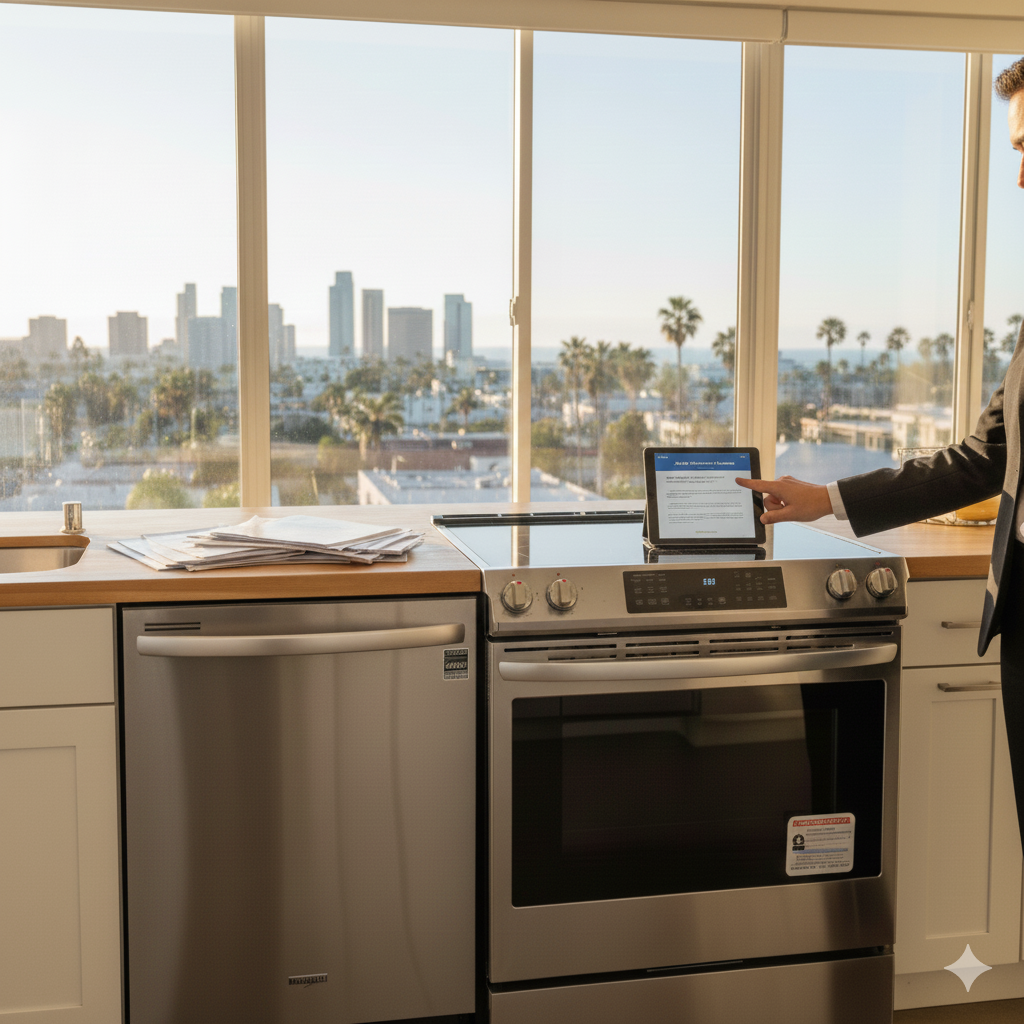
As a landlord attorney in Orange County specializing in evictions, I’m writing this to ensure you understand the full implications of Assembly Bill 628 before it takes effect on January 1, 2026. This isn’t just another compliance checkbox—it’s a fundamental shift in California’s habitability framework that will directly impact your eviction proceedings, maintenance obligations, and legal exposure.
The Core Requirement
AB 628 requires landlords to provide their tenants with a fridge and stove and repair or replace them if they stop working. More specifically, the law amends California Civil Code § 1941.1 to add two items to the list of what makes a dwelling “tenantable”:
- A working stove capable of safely generating heat for cooking purposes
- A working refrigerator capable of safely storing food (maintaining temperatures at 40°F or below)
When Does AB 628 Apply?
The trigger is critical: This will apply to leases entered into, amended or extended on or after January 1, 2026.
This means:
- Any new lease signed on or after January 1, 2026
- Any existing lease renewed or extended on or after January 1, 2026
- Any lease amendment executed on or after January 1, 2026
- Month-to-month tenancies where you formally renew or amend the agreement
Pre-2026 leases that continue on a month-to-month basis without formal renewal are not immediately subject to AB 628—but the moment you amend or renew that lease, compliance becomes mandatory.
The Eviction Connection: Why This Matters for Your Practice
Here’s where AB 628 becomes particularly dangerous for Orange County landlords: A malfunctioning refrigerator or stove could now trigger habitability disputes, repair-and-deduct claims, rent withholding, or serve as a defense against eviction.
In unlawful detainer proceedings, tenants can now assert habitability defenses based on appliance failures. When you file an eviction for nonpayment of rent, expect opposing counsel to:
- Assert rent withholding as justified due to uninhabitable conditions under § 1941.1
- File cross-complaints for breach of the implied warranty of habitability
- Request inspection orders to document appliance conditions
- Seek rent abatements retroactive to when the appliance failed
- Delay proceedings while habitability issues are litigated
The tenant can cite the broken, mandated appliance (the new habitability breach) as a justification for rent withholding, effectively challenging the legal premise of your unlawful detainer action.
The 30-Day Recall Rule
If the stove or fridge breaks or is recalled, the landlord will also be required to repair or replace the appliance within 30 days of notification.
This creates a hard deadline that plaintiffs’ attorneys will exploit. If you receive notice of a recall and fail to replace the appliance within 30 days, the unit becomes legally uninhabitable—providing tenants with immediate grounds for rent withholding and a powerful defense in any eviction proceeding.
Exemptions: Does Your Property in Orange County Qualify?
Permanent supportive housing and single-room occupancy units where kitchens are shared with others are excluded from this law.
The exemptions are narrow and include:
- Permanent supportive housing
- Single-room occupancy (SRO) units
- Residential hotels
- Dwelling units within housing facilities offering shared or communal kitchens (including assisted living facilities)
If you believe your property qualifies for an exemption, document this determination carefully with legal counsel. Courts will not be sympathetic to landlords who self-assess exemptions incorrectly.
The Tenant Opt-Out for Refrigerators
Orange County landlords cannot ask a tenant to buy their home’s stove, but there is limited flexibility with refrigerators.
Tenants may voluntarily agree to provide their own refrigerator, but only if:
- Both parties agree in writing when the lease is signed
- The lease includes specific opt-out language acknowledging the landlord’s legal obligation
- The tenant acknowledges responsibility for maintaining their own refrigerator
- The lease includes a clause allowing the tenant to provide 30 days’ written notice to end the opt-out and require the landlord to provide a refrigerator
This is not a loophole to avoid costs. You cannot condition tenancy on a tenant agreeing to bring their own refrigerator. Any attempt to do so violates AB 628 and exposes you to habitability claims.
Compliance Checklist for Orange County Landlords
To minimize your eviction litigation risk, take these steps immediately:
Before December 31, 2025:
- Audit every property to document current appliance status
- Identify which leases will renew or require amendment in 2026
- Budget for appliance purchases, delivery, and installation
- Select standardized appliance models to simplify future maintenance
- Update your lease templates to include AB 628 compliance language
- Create a tenant opt-out addendum for refrigerators that complies with the law
- Establish a system to monitor appliance recalls from the Consumer Product Safety Commission
Starting January 1, 2026:
- Ensure all new and renewed leases include working stoves and refrigerators
- Respond to appliance failure reports within your normal habitability response timeline (ideally within 24-48 hours)
- Document all appliance maintenance with photos, serial numbers, and work orders
- If you receive a recall notice, calendar the 30-day deadline immediately
- Maintain copies of purchase receipts, warranties, and installation documentation with each lease file
Cost Considerations
A basic stove and refrigerator can cost anywhere from $1,000 to $3,000 combined, depending on quality and features.
Beyond purchase costs, factor in:
- Delivery and installation fees
- Haul-away of old appliances
- Electrical or gas line upgrades for older properties
- Ongoing maintenance and repair reserves
- Eventual replacement costs (appliances typically last 10-15 years)
While you may be tempted to pass these costs to tenants through rent increases, remember that California’s statewide rent cap of 5% plus inflation (currently set by AB 1482, which expires mid-2026 but may be replaced with similar or stricter controls) applies throughout Orange County for covered properties.
What “Good Working Order” Means
The law requires appliances to be in “good working order,” but what does that mean in practice? A refrigerator that can keep temperatures at 40°F or below can protect most food products.
For refrigerators:
- Must maintain safe food storage temperatures (40°F or below)
- Door seals must function properly
- Shelving and drawers should be intact and functional
- No excessive frost buildup or leaking
For stoves:
- All burners (or heating elements) must work
- Oven must heat to and maintain set temperatures
- Gas connections must be safe and leak-free
- Safety features (automatic shut-offs, etc.) must function
Don’t assume that because an appliance “technically works,” it meets the legal standard. A refrigerator that struggles to stay cold or a stove with only two working burners will likely fail the habitability test in court.
Documentation Is Your Best Defense
When defending against habitability claims in eviction proceedings, your documentation will make or break your case. For every unit:
- Photograph appliances at move-in with dates and serial numbers visible
- Keep a maintenance log of all service calls, repairs, and replacements
- Retain copies of recall checks and responses
- Document tenant-reported issues with timestamps and your response times
- Store warranty information and purchase receipts with the lease file
If a tenant claims you failed to maintain an appliance, you need contemporaneous records proving otherwise. “I always kept it working” won’t hold up in court without documentation.
The Bigger Picture: AB 628 in Context
AB 628 functions as one more onerous regulatory layer placed atop an already complex legal framework, particularly the stringent tenant protections provided by the Tenant Protection Act of 2019 (AB 1482).
AB 628 doesn’t exist in isolation. It compounds with:
- Statewide rent caps under AB 1482
- Just Cause eviction requirements
- Local rent control ordinances (particularly in coastal California cities, including several Orange County municipalities)
- Increasingly tenant-friendly court interpretations of habitability
The cumulative effect is a narrowing window for profitable rental operations and increased litigation risk. From an eviction attorney’s perspective, every new habitability requirement gives tenants another potential defense, another reason to withhold rent, and another basis to delay eviction proceedings.
Practical Guidance for Eviction Prevention
The best eviction is the one you never have to file. Here’s how to minimize your AB 628-related litigation risk:
- Be proactive, not reactive. Don’t wait for tenants to complain about appliances. Schedule annual inspections and address issues before they become habitability violations.
- Respond immediately to appliance issues. When a tenant reports a broken refrigerator or stove, treat it with the same urgency you’d treat a broken heater or plumbing leak—because legally, it now has the same status.
- Consider loaner appliances. If a repair will take more than 24-48 hours, having a basic loaner refrigerator available can prevent a habitability claim while you source a replacement.
- Never retaliate. If a tenant withholds rent due to an appliance issue, do not file for eviction until you’ve verified compliance. Filing an eviction while the unit is legally uninhabitable will result in an embarrassing loss and potential sanctions.
- Update your lease templates now. Work with counsel to ensure your 2026 leases properly address AB 628, including appropriate language about maintenance responsibilities and opt-out procedures.
What About Rent Increases?
Many landlords are asking: Can I raise the rent to cover these new costs?
The short answer is: it depends on your local rent control status and AB 1482 limitations. Throughout Orange County, you’re subject to the statewide rent cap (5% plus local inflation) for most properties built more than 15 years ago. Some Orange County cities also have additional local rent control measures. Adding appliances doesn’t create an exemption from rent control.
That said, when marketing units, you can position “included stove and refrigerator with landlord-provided maintenance” as a value-add that justifies competitive pricing—particularly compared to units where tenants must provide their own appliances.
Final Thoughts: Prepare Now or Pay Later
AB 628 takes effect in just days. Landlords who treat this as a minor compliance issue will find themselves facing expensive habitability claims and prolonged eviction litigation throughout 2026.
Those who prepare now—by auditing properties, updating leases, budgeting for appliances, and establishing robust maintenance protocols—will be positioned to avoid these problems entirely.
From an Orange County eviction attorney‘s perspective, I’d much rather help you draft compliant leases and maintenance procedures today than defend you against habitability claims and tenant counterclaims six months from now.
The time to act is now. Review your portfolio, consult with legal counsel, and ensure every property that will trigger AB 628 in 2026 is fully compliant before you sign or renew that next lease.
This article is provided for informational purposes and does not constitute legal advice. Landlords should consult with qualified legal counsel regarding their specific circumstances and compliance obligations under AB 628.
