
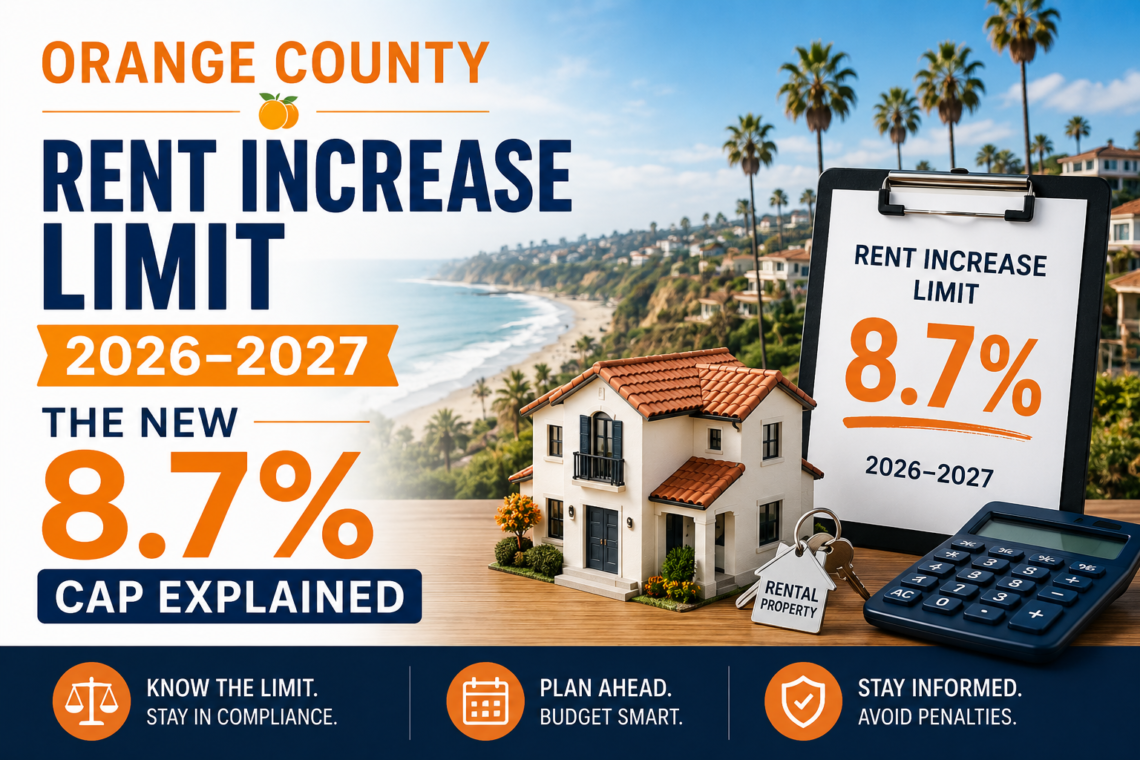
Orange County’s maximum allowable rent increase rises to 8.7% for any increase taking effect between August 1, 2026 and July 31, 2027.
That is up from 8.0%. If you own residential rental property in Orange County, this is the number that governs every rent increase you serve for the next twelve months — unless your property sits in Santa Ana, where a far stricter local ordinance applies, or is exempt from the state cap entirely.
Here is the new figure, the math at common Orange County rent levels, the Santa Ana exception, and the timing mistake that generates the most disputes when the cap moves upward.
The Short Answer
| Maximum allowable increase | 8.7% |
| Applies to effective dates | August 1, 2026 – July 31, 2027 |
| Formula | 5% base + 3.7% Los Angeles–Long Beach–Anaheim CPI |
| Prior year cap | 8.0% (5% + 3.0% CPI) |
| Statutory authority | Cal. Civil Code § 1947.12 (AB 1482) |
| Hard ceiling | 10%, regardless of CPI |
| Santa Ana properties | 2.87% under local ordinance — not 8.7% |
The cap applies per 12-month period, not per increase. Under AB 1482 you may raise rent twice within a 12-month window, but the combined increase cannot exceed 8.7%. Santa Ana permits only one increase per 12 months.
Why the Number Went Up
California’s Tenant Protection Act sets the maximum annual rent increase at 5% plus the year-over-year change in the regional Consumer Price Index, never exceeding 10%. The 5% base is fixed by statute. The CPI input resets every August 1.
Orange County falls within the Los Angeles–Long Beach–Anaheim CPI region, and the statute uses the April-to-April change. The Bureau of Labor Statistics reported that figure at 3.7% for the year ending April 2026, up from 3.0% the year before.
5% + 3.7% = 8.7%.
Worth noting for owners with properties in both markets: San Diego County moved in the opposite direction this year, dropping to 8.2%. Same statute, same week, different CPI regions. A portfolio spanning county lines cannot use one number.
Orange County vs. Other California Regions
| Region | Cap, 8/1/2026 – 7/31/2027 |
| Orange & Los Angeles Counties | 8.7% |
| San Diego County | 8.2% |
| Riverside & San Bernardino | 8.1% |
| Core Bay Area counties | 8.8% |
| Remainder of California | 8.6% |
The Date That Matters Is the Effective Date — Not the Notice Date
When the cap rises, the timing error runs in a particular direction, and it is worth naming precisely.
The applicable cap is determined by the date the increase takes effect, not the date the notice was served.
An increase taking effect on or after August 1, 2026 may use 8.7%, even if the notice went out in July. But the reverse also holds: an increase taking effect on or before July 31, 2026 is still limited to 8.0%, no matter when you drafted the notice or that the higher figure had already been published.
The published-in-May, effective-in-June scenario is the trap. The 8.7% number was public well before it became operative. A notice served in June 2026 for a July 1 effective date that used 8.7% was an over-cap demand — the cap that month was 8.0%.
If you have notices in flight, match each one to its effective date, not to today’s number.
Running the Math
Multiply current rent by 1.087 to find the maximum lawful new rent.
| Current Monthly Rent | Maximum Increase | Maximum New Rent |
| $2,000 | $174.00 | $2,174.00 |
| $2,400 | $208.80 | $2,608.80 |
| $2,800 | $243.60 | $3,043.60 |
| $3,200 | $278.40 | $3,478.40 |
| $3,600 | $313.20 | $3,913.20 |
| $4,500 | $391.50 | $4,891.50 |
Two practical cautions:
Round down, not up. Rounding a $3,043.60 ceiling to $3,050 is a $6.40 over-cap demand. Small in dollars — but the statute contains no de minimis exception.
Count increases already taken in the last 12 months. If you raised rent 4% in February 2026, you have 4.7% of headroom left in that window, not a fresh 8.7%.
Santa Ana Is a Different Law Entirely
This is the single most consequential distinction for Orange County landlords, and it is where we see the most expensive mistakes.
The City of Santa Ana has its own Rent Stabilization and Just Cause Eviction Ordinance (Ordinance No. NS-3027, Santa Ana Municipal Code § 8-3160 et seq.). Where it applies, it governs instead of the state cap — and it is dramatically more restrictive.
| AB 1482 (most of Orange County) | Santa Ana ordinance | |
| Current cap | 8.7% | 2.87% |
| Cap period | Aug 1 – Jul 31 | Sept 1 – Aug 31 |
| Formula | 5% + regional CPI, max 10% | Lesser of 3% or 80% of CPI change |
| Increases per 12 months | Two, combined within cap | One only |
| Registration prerequisite | None | Rental Registry registration required |
Four things about this deserve emphasis:
The gap is enormous. On a $2,400 unit, the AB 1482 cap permits a $208.80 increase. The Santa Ana cap permits $68.88. A landlord who applies the state number to a Santa Ana property has over-demanded by roughly $140 per month.
The calendar is different. Santa Ana’s year runs September 1 through August 31, not August 1 through July 31. The current 2.87% figure took effect September 1, 2026 and runs through August 31, 2027. The prior period was 2.42%, and the one before that 3.00%. There is a one-month window each year where the state cap has reset but Santa Ana’s has not — a genuine trap for anyone managing mixed portfolios on a single calendar.
Coverage is set by Costa-Hawkins vintage, not the rolling 15-year rule. The Santa Ana cap applies to residential structures built on or before February 1, 1995, and to mobilehome parks established before 1990 regardless of ownership. That is a fixed date, not a moving window — a building covered last year is covered this year.
An increase can be void for reasons unrelated to the percentage. Santa Ana conditions rent increases on the property being properly registered in the Rental Registry, on code compliance and completed repairs, and on the tenant having received written notice of their rights under the ordinance. A perfectly calculated 2.87% increase on an unregistered unit can still fail. This is a compliance structure, not just a number.
Note also that the Rental Registry fee pass-through — up to 50% of the fee, capped at $50, spread across twelve monthly installments — is not treated as rent and does not count toward the allowable increase. Do not fold it into the increase calculation.
The Rest of Orange County
Irvine, Anaheim, Huntington Beach, Costa Mesa, Fullerton, and the county’s other cities have no local rent stabilization ordinance. Those properties follow the state cap of 8.7%.
That said, “no local rent cap” is not “no local rules.” Verify current municipal requirements before serving notice, particularly in cities that have considered tenant protection measures recently. Local ordinances change faster than state law.
Is Your Property Even Covered?
The 8.7% state cap applies only to covered units. Several categories are exempt:
- New construction. Housing issued a certificate of occupancy within the previous 15 years. This is a rolling exemption — a building exempt three years ago may not be exempt today. Re-verify annually.
- Single-family homes and condominiums, but only if (1) the property is not owned by a corporation, a REIT, or an LLC with at least one corporate member, and (2) the tenant received the statutorily required written exemption notice. Without the notice, the exemption does not apply regardless of ownership structure.
- Owner-occupied duplexes, where the owner has occupied one unit as their principal residence since the tenancy began.
- Deed-restricted affordable housing, dormitories, and certain owner-occupied share arrangements.
On the single-family exemption specifically: the required notice language must be delivered properly, and for tenancies entered into or renewed after July 1, 2020 it generally must appear in the lease itself. Owners who assume the exemption applies without confirming the notice was given are the ones who end up litigating it.
Important: exemption from AB 1482 does not automatically mean exemption from the Santa Ana ordinance. The two schemes define coverage differently — AB 1482 uses a rolling 15-year construction window, while Santa Ana uses the fixed February 1, 1995 date. A Santa Ana property can be exempt from the state cap and still fully subject to the local one. Run both analyses.
The Orange County Emergency Declaration: A Wrinkle Most Guides Miss
There is a third layer that applies to Orange County right now and to no other California county, and it is the one we most often find landlords have never heard of.
Following the Garden Grove chemical incident, the Governor proclaimed a state of emergency for Orange County on May 23, 2026, followed by a Presidential emergency declaration. That triggered California’s anti-price-gouging statute, Penal Code § 396.
Why this matters even though the rental provision has lapsed
Section 396(e) makes it unlawful to increase the rental price advertised, offered, or charged for housing by more than 10% — and it applies to rental housing with an initial lease term of one year or less, including mobilehome park and campground spaces.
The statutory window for the housing protection is 30 days from the proclamation. Cal OES currently lists Orange County’s active protections under § 396(c) — the 180-day repair and reconstruction category — running through November 19, 2026. The 30-day housing window under § 396(e) ran from May 23, 2026 and has lapsed absent an extension.
So the 10% rental ceiling is not in force today. Four reasons it still belongs in your file:
1. It governed exempt properties during that window. For AB 1482-covered units the point was academic — the cap was 8.0% then and 8.7% now, both already below 10%. But exempt properties normally have no cap at all. During the emergency window they did. If you raised rent on a new-construction unit or a qualifying single-family home with an effective date in that period, § 396(e) applied to it. That is the single most likely place to find an unlawful increase on a property you believed was uncapped.
2. It restricted evict-and-re-rent. Section 396(f) makes it unlawful to evict a residential tenant and then rent, or offer to rent, to someone else at a price higher than the evicted tenant could have been charged under § 396. Continuing an eviction lawfully begun before the proclamation was not a violation. If you turned over a unit in Orange County in late May or June 2026, the re-rental price is worth a look.
3. The construction and repair protection is still live through November 19, 2026. Relevant if you are pricing repair pass-throughs or costing out substantial-remodel work.
4. Protections can be extended. They have been elsewhere — Los Angeles County extended its wildfire-related restrictions repeatedly through 2026. Check the Cal OES price gouging page before serving an increase on an exempt Orange County property rather than assuming the window closed.
Two further points. Section 396(e) does not authorize charging above a local rent control cap, so Santa Ana’s 2.87% continues to govern there regardless. And a greater increase is not unlawful where the owner can prove it is directly attributable to costs for repairs or additions beyond normal maintenance amortized over the rental term, or was contractually agreed to by the tenant before the declaration — a genuine defense, but one requiring documentation prepared in advance rather than assembled afterward.
Violations are a misdemeanor carrying up to one year in county jail, a fine of up to $10,000, or both, and also constitute an unlawful business practice under Business and Professions Code § 17200.
Notice Requirements
The rent cap and the notice statute are separate obligations. Civil Code § 827 requires:
- At least 30 days’ written notice where the increase, combined with any other increases in the prior 12 months, totals 10% or less.
- At least 90 days’ written notice where the increase exceeds 10%.
Because the statewide cap can never exceed 10%, covered units will effectively always fall in the 30-day category. Exempt properties can lawfully exceed 10% — and those increases require 90 days.
Santa Ana imposes its own notice content requirements on top of § 827 timing. Notice must be served in a legally sufficient manner; add five days if serving by mail.
Were Your Past Increases Lawful? Prior-Year Caps and Why They Still Matter
The cap resets every August 1, and each increase is measured against the cap in force on its effective date. An increase served in 2023 is judged by the 2023–2024 number, not today’s.
If you have held a unit through several increases — or acquired a property mid-tenancy and inherited someone else’s rent history — you need the full table:
| Effective Dates | Orange County Cap | CPI Input |
| August 1, 2021 – July 31, 2022 | 8.6% | 3.6% |
| August 1, 2022 – July 31, 2023 | 10% | 7.9% (ceiling applied) |
| August 1, 2023 – July 31, 2024 | 8.8% | 3.8% |
| August 1, 2024 – July 31, 2025 | 8.9% | 3.9% |
| August 1, 2025 – July 31, 2026 | 8.0% | 3.0% |
| August 1, 2026 – July 31, 2027 | 8.7% | 3.7% |
These are Orange County figures. They are not interchangeable with San Diego‘s or Riverside’s. Orange County shares the Los Angeles–Long Beach–Anaheim index with Los Angeles County, and that index diverged meaningfully from San Diego’s in four of the last five years. Anyone auditing a rent history against the wrong region’s table will reach the wrong conclusion.
The 10% figure in 2022–2023 reflects the statutory ceiling, not the formula. Regional inflation ran at 7.9% that year, so 5% + CPI would have produced 12.9% — the hard cap governed. A landlord who took 10% in that window was within the law. A landlord who assumed 10% remained available and took it again in 2023–2024 was not; the cap that year was 8.8%.
Santa Ana properties require a separate audit against the local schedule: 3.00% for September 2024–August 2025, 2.42% for September 2025–August 2026, and 2.87% for September 2026–August 2027.
Why an Old Over-Cap Increase Is Not a Closed Issue
Three consequences follow from an unlawful past increase, and the second and third are the ones that surprise people.
1. Direct exposure for the overage. The tenant may have a claim for the amount collected above the lawful maximum, discussed in the next section.
2. It corrupts the base rent going forward. Civil Code § 1947.12 measures the allowable increase against the lowest gross rental rate charged during the preceding 12 months. If a prior increase was unlawful, the argument follows that the lawful base was never the inflated figure — and every increase stacked on top of it compounds the original error. A single bad increase in 2023 can make three subsequent, individually reasonable-looking increases unlawful too. Compounding runs in the wrong direction here.
3. It can defeat an unlawful detainer. This is the practical risk that matters most. A three-day notice to pay rent or quit must state the amount of rent actually due. If the rent demanded includes an unlawful overage — even a small one — the notice overstates what is owed and is subject to challenge as defective. Landlords have lost otherwise-strong nonpayment cases on exactly this point, then had to start over with a corrected notice while arrears kept accruing.
For Santa Ana properties the exposure is compounded, because an increase can be defective for registration or code-compliance reasons even when the percentage was right.
If you are preparing to serve a notice on a long-term tenant, audit the rent history first. Discovering a 2023 miscalculation in your own files is inconvenient. Discovering it in a tenant’s answer is expensive.
How Far Back Does Liability Reach?
For rent cap claims, a tenant generally has three years from the date the cause of action accrued. Because liability can attach each time an over-cap payment is demanded or accepted, the practical reach can extend to the earliest over-cap payment still inside that window rather than to the date the increase was first served.
A further wrinkle: the enhanced remedies described below arrived with SB 567 and took effect April 1, 2024. Increases predating that date are governed by the prior framework, under which the primary consequence was that the excess was simply not owed. Whether and how the newer remedies apply to conduct that began before April 2024 but continued after it is a fact-specific question, and one worth asking a lawyer before you decide an old increase is safely behind you.
Running a Rent History Audit
For each unit with a tenancy predating August 2025:
- Determine which scheme applies — AB 1482 or the Santa Ana ordinance — for each year of the tenancy.
- Pull every rent increase notice served during the tenancy, with its effective date.
- Match each one to the cap in force on that effective date using the correct table above — not the cap in force when the notice was drafted, and not another county’s figures.
- Confirm the unit was covered in each of those years. The 15-year new-construction exemption rolls, so a unit may have been exempt in 2022 and covered by 2025.
- Check for stacking. Under AB 1482, two increases inside one 12-month window must total no more than that window’s cap. Under the Santa Ana ordinance, a second increase in a 12-month period is impermissible regardless of amount.
- For Santa Ana units, verify registration and compliance status for each year an increase was taken.
- Recalculate the lawful base rent forward from the first defective increase, if you find one.
- Decide on remediation before you serve anything new.
Self-correcting is almost always cheaper than being corrected. It also removes the defect from any notice you serve afterward.
What Non-Compliance Costs
Since SB 567 took effect in April 2024, the penalties for exceeding the cap are considerably sharper than they used to be.
An owner who demands, accepts, receives, or retains rent above the maximum allowable amount may be liable to the tenant for:
- Injunctive relief
- Damages equal to the amount by which the payment exceeded the lawful maximum
- Reasonable attorney’s fees and costs, at the court’s discretion
- Up to three times the excess amount, on a showing that the owner acted willfully or with oppression, fraud, or malice
The Attorney General, and the city attorney or county counsel where the unit is located, may also enforce the rent cap provisions and seek injunctive relief. Tenants have up to three years to bring a claim.
Note the structure carefully: liability attaches to demanding an over-cap rent, not only to collecting one. A defective notice can create exposure before a single dollar changes hands.
Santa Ana maintains its own administrative enforcement mechanism, including mediation and appeals processes, separate from these civil remedies.
Compliance Checklist for August 1
- Determine which cap governs. Santa Ana property? 2.87%, on a September calendar. Anywhere else in Orange County? 8.7%, on an August calendar.
- Confirm coverage. Is the unit exempt from the applicable scheme? If you’re relying on the single-family exemption, locate the notice in the lease file before you rely on it.
- If the unit is exempt, check current emergency status on the Cal OES price gouging page before treating it as uncapped. Orange County is under active protections through November 2026 for some categories.
- Check the effective date. Increases effective on or before July 31, 2026 are still capped at 8.0%.
- Subtract prior increases taken in the last 12 months.
- Audit the rent history on any tenancy predating August 2025, and verify the current rent is a lawful base before you build on it.
- For Santa Ana units, confirm registration and code compliance before the increase can take effect.
- Round down.
- Serve proper notice — 30 days minimum for covered units, plus mailing time, plus any local content requirements.
- Document everything. Keep the calculation, the notice, and proof of service together.
Frequently Asked Questions
What is the maximum rent increase in Orange County for 2026? 8.7% for any increase taking effect between August 1, 2026 and July 31, 2027, on properties covered by California’s Tenant Protection Act. This is calculated as the statutory 5% base plus the 3.7% Los Angeles–Long Beach–Anaheim CPI change. Santa Ana properties are capped at 2.87% under a separate local ordinance.
Why did Orange County’s rent cap go up from 8.0% to 8.7%? Regional inflation rose. The formula is fixed at 5% plus regional CPI. The Los Angeles–Long Beach–Anaheim CPI input increased from 3.0% to 3.7%, raising the cap by the same 0.7 points.
Is the Orange County cap the same as San Diego’s? No. San Diego County’s cap is 8.2% for the same period. Orange County shares a CPI region with Los Angeles County, not with San Diego. Using the wrong region’s figure is a common and consequential error.
What is the rent increase limit in Santa Ana? 2.87% for the period September 1, 2026 through August 31, 2027, under the city’s Rent Stabilization and Just Cause Eviction Ordinance. Santa Ana also limits landlords to one increase per 12 months and requires Rental Registry registration and code compliance before an increase can take effect.
Do Irvine, Anaheim, or Huntington Beach have rent control? No. Those cities have no local rent stabilization ordinance and follow the state cap of 8.7%. Santa Ana is currently the only Orange County city with its own rent cap.
I served a notice in June at 8.7%. Is it valid? Only if the increase takes effect on or after August 1, 2026. If the effective date fell on or before July 31, the increase was limited to 8.0% and the notice should be corrected.
Can I raise rent twice in a year? Under AB 1482, yes — but the combined increase across any 12-month period cannot exceed 8.7%. Under the Santa Ana ordinance, only one increase is permitted in any 12-month period.
What were the Orange County rent caps in prior years? 8.6% for August 1, 2021–July 31, 2022; 10% for August 1, 2022–July 31, 2023; 8.8% for August 1, 2023–July 31, 2024; 8.9% for August 1, 2024–July 31, 2025; and 8.0% for August 1, 2025–July 31, 2026. Each increase is measured against the cap in force on its effective date.
Does the Orange County emergency declaration limit my rent increase? The Governor’s May 23, 2026 proclamation triggered Penal Code § 396, which caps rental increases at 10%. The housing provision runs 30 days and has lapsed absent extension, though other categories remain active through November 19, 2026. It mattered most for exempt properties, which otherwise have no cap. Check current status on the Cal OES price gouging page before raising rent on an exempt Orange County unit.
My property is exempt from AB 1482. Is there really no limit on how much I can raise rent? Usually there is no state cap — but not always. During a declared emergency, Penal Code § 396 caps increases at 10% even on exempt properties. Orange County has been under an emergency declaration since May 2026, so an exempt-property increase with an effective date in the covered window may have been subject to that ceiling.
I think I raised rent too much in a prior year. What happens now? Three things are in play: potential liability for the overage, the risk that the current rent is not a lawful base for future increases, and the possibility that a pay-or-quit notice stating the inflated amount would be defective. Have the rent history reviewed before serving any new notice.
How far back can a tenant sue over an illegal rent increase? Generally three years from when the claim accrued, though the analysis is fact-specific — particularly for increases predating April 1, 2024, when the current remedies took effect.
Talk to an Orange County Landlord Attorney
Rent cap compliance is arithmetic until it isn’t. Santa Ana’s overlay, exemption questions, mid-window increases, portfolios spanning multiple CPI regions, and inherited rent histories are where a defensible increase becomes a disputed one — and where a defective notice can undermine an unlawful detainer months later.
If you have questions about a specific increase, a tenant disputing one, or a notice you’ve already served, contact our eviction attorney in Orange County for a consultation.
This article is provided for general informational purposes and does not constitute legal advice. Rent cap figures reflect published CPI data as of July 2026 and are subject to annual reset. Local ordinances change; verify current municipal requirements before serving notice.
